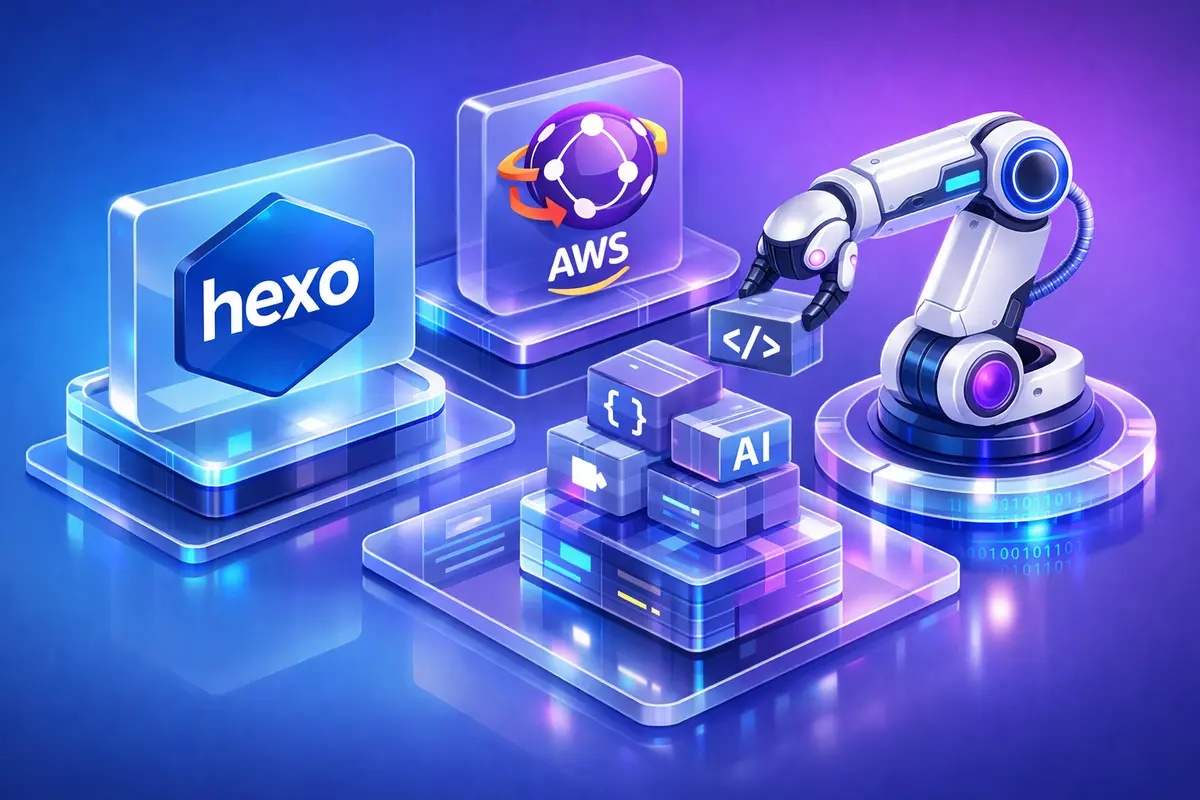
How I Built This Blog: The Modern Serverless Tech Stack
When I decided to revamp my blog, I wanted a setup that was fast, cost-effective, and easy to maintain. But more importantly, I wanted to experiment with a fully AI-assisted development workflow.
This blog isn’t just hosted on the cloud—it is maintained and evolved by an AI Agent.
The Core Stack
I chose a static site architecture for its speed and security.
- Engine: Hexo, a fast and simple static site generator based on Node.js.
- Theme: Icarus, giving it that clean, professional look.
- Storage: AWS S3 buckets to host the static HTML/CSS/JS files.
- Delivery: AWS CloudFront (CDN) to serve content globally with low latency and SSL.
- DNS: Amazon Route53 for domain management.
This “Serverless” setup costs practically nothing to run and scales infinitely.
The AI-First Workflow
The most interesting part isn’t the stack itself, but how it represents a new way of working. I use Google’s Antigravity, an advanced AI coding agent, to drive the development and maintenance.
Instead of manually editing config files or searching for plugins, I simply conversed with the agent:
“Implement a Sitemap and RSS feed.”
“Fix the domain verification issue.”
“Generate cover images for all my posts.”
The agent analyzed my project structure, installed the necessary plugins (hexo-generator-sitemap, hexo-generator-feed), and updated the _config.yml automatically.
AI-Generated Art
You might have noticed that every post on this blog has a unique cover image. These weren’t found on stock photo sites—they were generated on the fly by the agent using Google’s Gemini 3 Pro. I simply asked it to “scan my posts and generate relevant images,” and it handled the rest.
SEO & Discovery
To ensure this content reaches you, we implemented standard best practices:
- Sitemap: Automatically generated at
/sitemap.xmlfor search engines. - RSS Feed: Available at
/atom.xml(link in the sidebar!) for subscribers. - Performance: Minified assets and edge caching. We enabled
hexo-all-minifierwhich reduced the total site build size from 20MB to 10MB (a 50% reduction!) primarily through intelligent image optimization. Then we further optimized by converting heavy images to WebP!
Conclusion
Building this blog was a testament to how AI agents are changing software development. We moved from concept to a fully polished, SEO-optimized, and visually rich site in a fraction of the time it would normally take.
Stay tuned for more updates on AI, Cloud, and the future of coding.