I have a confession: I’ve abandoned more personal projects than I’d like to admit. Not because they were bad ideas, but because I got stuck in what I call the “engineer’s dilemma.”
The All-or-Nothing Trap
As engineers, we’re wired to think in systems. When I get an idea for a content workflow or automation project, my brain immediately jumps to the end state: a fully automated pipeline that handles everything from ideation to publishing. No manual steps. No human intervention. Pure automation.
The problem? That vision is often so ambitious that when one piece doesn’t work perfectly, the whole thing feels broken. I’d hit a snag with an API integration, or a tool wouldn’t behave as expected, and suddenly the project felt like a failure. So I’d shelve it and move on to the next shiny idea.
What GenAI Taught Me
Working with AI tools over the past year has fundamentally changed how I think about automation. The lesson is simple but powerful: automate in parts, not end-to-end.
Here’s what this looks like in practice:
-
Identify the tedious parts - Not everything needs automation. Find the steps that are repetitive, time-consuming, or error-prone.
-
Automate those specific parts - Build small, focused automations that handle just those steps well.
-
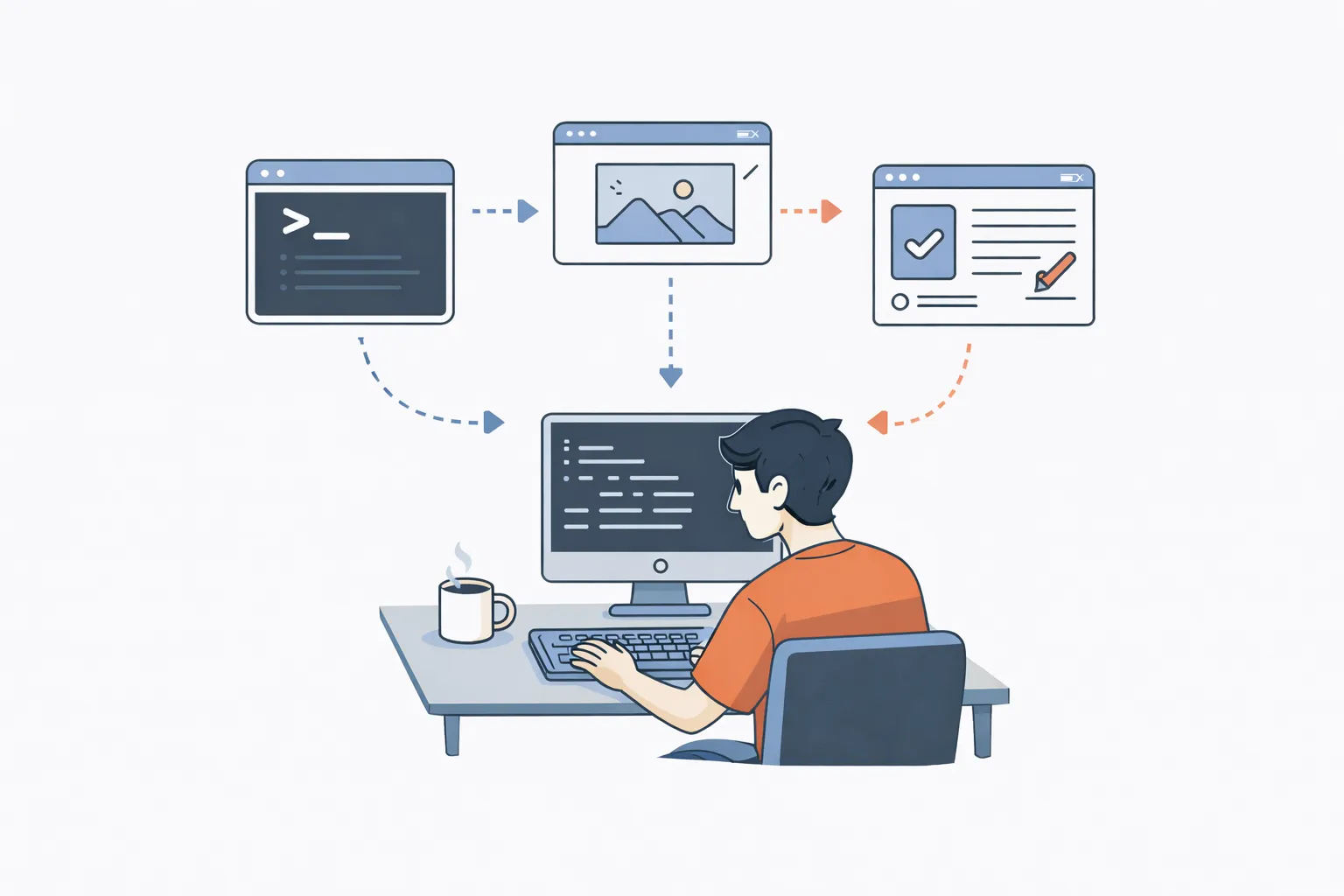
Stay in the loop - Use yourself as the human connector between automated steps. You’re the orchestrator, not a bottleneck.
The Economics Make Sense Too
There’s also a practical cost argument. Some tools are significantly cheaper (or even free) via their UI compared to API access. Take image generation: ChatGPT’s API costs roughly 10 cents per image, but with a subscription, you can generate many images through the UI at no additional cost. Why build an API integration when the UI works fine for your volume?
Same goes for tools that don’t have APIs at all, or where the API is prohibitively expensive. Being human-in-the-loop lets you leverage these tools without building complex integrations.
HITL Is a Feature, Not a Bug
For content workflows specifically, having a human in the loop isn’t just acceptable - it’s often preferable. A fully automated content pipeline risks:
- AI hallucinations slipping through unchecked
- AI slop - content that’s technically correct but lacks personality or insight
- Brand inconsistency when the AI drifts from your voice
- Factual errors that damage credibility
When I review and approve content before it goes out, I catch these issues. The automation handles the grunt work; I provide the judgment.
A Practical Example
My current content workflow mixes automation with manual steps:
- Automated: Transcription, initial drafts, formatting, scheduling
- Manual: Topic selection, final review, image generation (via UI), publishing approval
This hybrid approach means I actually ship content instead of endlessly tinkering with a perfect-but-never-finished automation pipeline.
The Mindset Shift
The old me would have seen this as “incomplete automation.” The new me recognizes it as pragmatic automation. I’m not building a system to replace myself; I’m building tools to amplify what I can do.
If you’re like me and have a graveyard of abandoned automation projects, try this: pick one small, annoying part of a workflow and automate just that. Ship it. Use it. Then maybe automate the next part. Or don’t - maybe the manual step is fine.
The goal isn’t to remove yourself from the loop. It’s to make the loop more efficient.
Written on February 2, 2026
#Automation #HITL #GenAI #Productivity