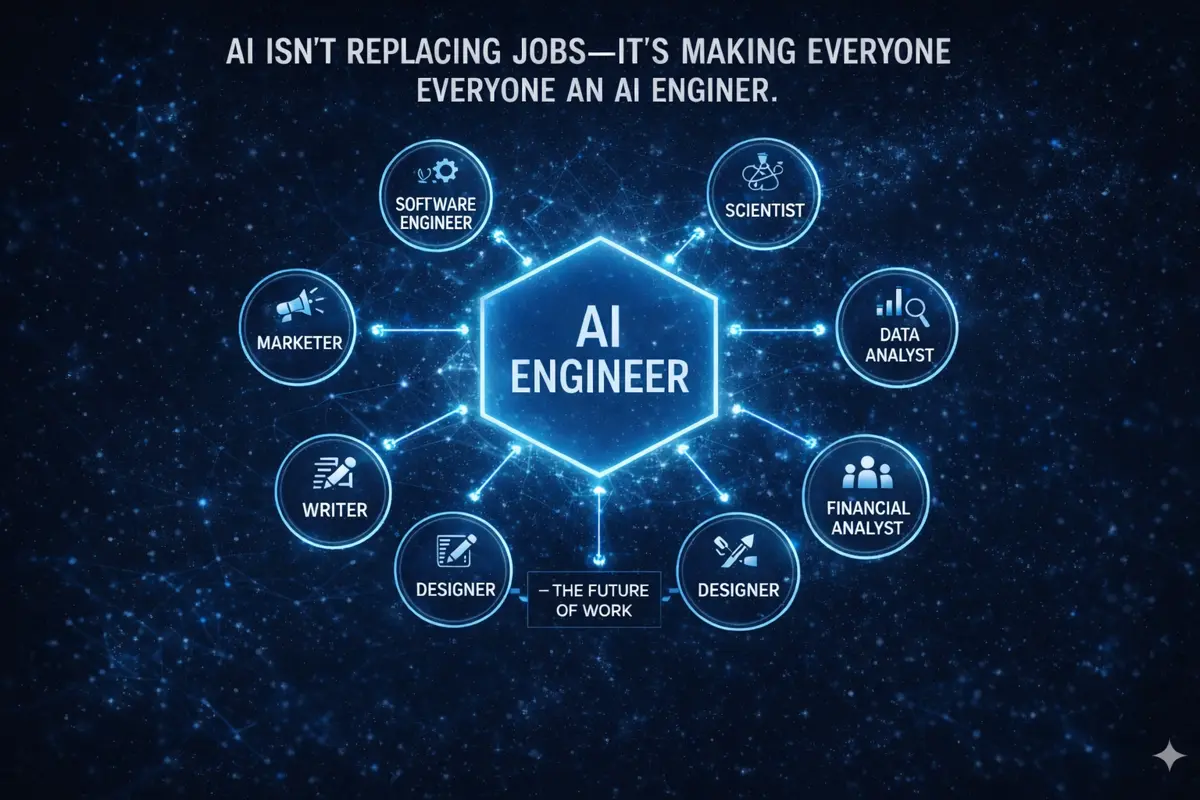
AI Isn't Replacing Jobs—It's Making Everyone an AI Engineer
There’s a fear running through every industry right now: AI is coming for my job.
Writers, designers, coders—they’re all worried about ChatGPT and Claude. Especially when a new model drops and demonstrates capabilities that seemed impossible six months ago. Each release ratchets up the anxiety: How long until this thing can do what I do?
But after a year of building heavily with these tools, I think this framing misses the point entirely.
AI isn’t replacing jobs. It’s replacing how jobs get done.
And the skill that’s emerging as universal? AI Engineering.
“The Hottest New Programming Language Is English”
Andrej Karpathy—former Tesla AI Director, OpenAI founding member—put it perfectly:
“The hottest new programming language is English.”
This isn’t a joke. It’s the new reality.
The ability to clearly articulate intent, break down problems, and iterate on AI outputs is becoming the core competency across every role. Whether you’re deploying infrastructure or designing a logo, the workflow is the same: define intent, prompt the system, validate the output, iterate.
That’s engineering. And everyone is doing it now.
What “AI Engineering” Actually Looks Like
Let me make this concrete with examples from my own work.
Cloud & DevOps → Prompt Engineering
In The Speed of AI-Assisted Development, I fixed a Python Lambda function, debugged a GitHub Actions pipeline, and deployed a new frontend—all in under an hour. I didn’t write the MIME parsing logic or look up the S3 CLI flags. I described what I needed. The agent wrote the code.
When I consolidated my domains using CloudFront Functions, I didn’t memorize the request.headers.host.value syntax. I defined the architecture—“redirect these hosts to this target with a 301”—and engineered the prompt to get working code.
The engineering wasn’t typing. The engineering was:
- Choosing the right architecture (CloudFront Function vs. S3 redirect buckets)
- Validating the AI’s logic against edge cases
- Orchestrating the deployment
Content Creation → Prompt Engineering
When I write for this blog, I’m often acting as an editor-in-chief for an AI staff writer. I provide structure, context, and voice. The AI drafts. I refine.
When I need visuals, I don’t open Photoshop. As I explored in AI Image Generation, I engineer the prompt—tweaking negative prompts, adjusting seeds, iterating until the output matches my vision.
Same discipline. Different domain.
Every Role Is Becoming AI Engineering
Think about what’s actually happening across industries:
| Traditional Role | New Reality |
|---|---|
| Software Engineer | Orchestrating coding agents, validating AI-generated code |
| DevOps Engineer | Prompting infrastructure agents, reviewing IaC outputs |
| Writer | Directing LLMs, editing AI drafts for voice and accuracy |
| Designer | Engineering image generation prompts, curating outputs |
| Manager | Using AI for strategy synthesis, communication drafting |
The job titles may stay the same. But the core skill is converging: the ability to effectively collaborate with AI systems.
That’s AI Engineering.
The Question That Matters Now
As I wrote earlier today in Ask Better Questions or Get Left Behind, Jensen Huang’s advice cuts through the noise:
“How does AI help me do my job better?”
Not hypothetically. Not someday. Today. In your role.
The people who keep asking that question—and keep refining their ability to work with AI—are the ones building leverage. Everyone else is just using a smarter Google.
The Human Stays in the Loop
Does this mean humans become irrelevant? No. As I discussed in Humans in the Loop in the AI Era, this shift makes human oversight more strategic, not less.
When AI handles execution, humans provide:
- Judgment — Is this output correct? Appropriate? Good?
- Context — What’s the real problem we’re solving?
- Direction — Where should we go next?
AI isn’t replacing your job. It’s promoting you to Lead Engineer of your own AI workforce.
Final Thought
The hottest programming language is English.
The emerging universal skill is AI Engineering.
And the question isn’t whether AI will change your job.
It’s whether you’ll learn to engineer with it—or get left behind.